

The Last Rat of Tobruk

Share
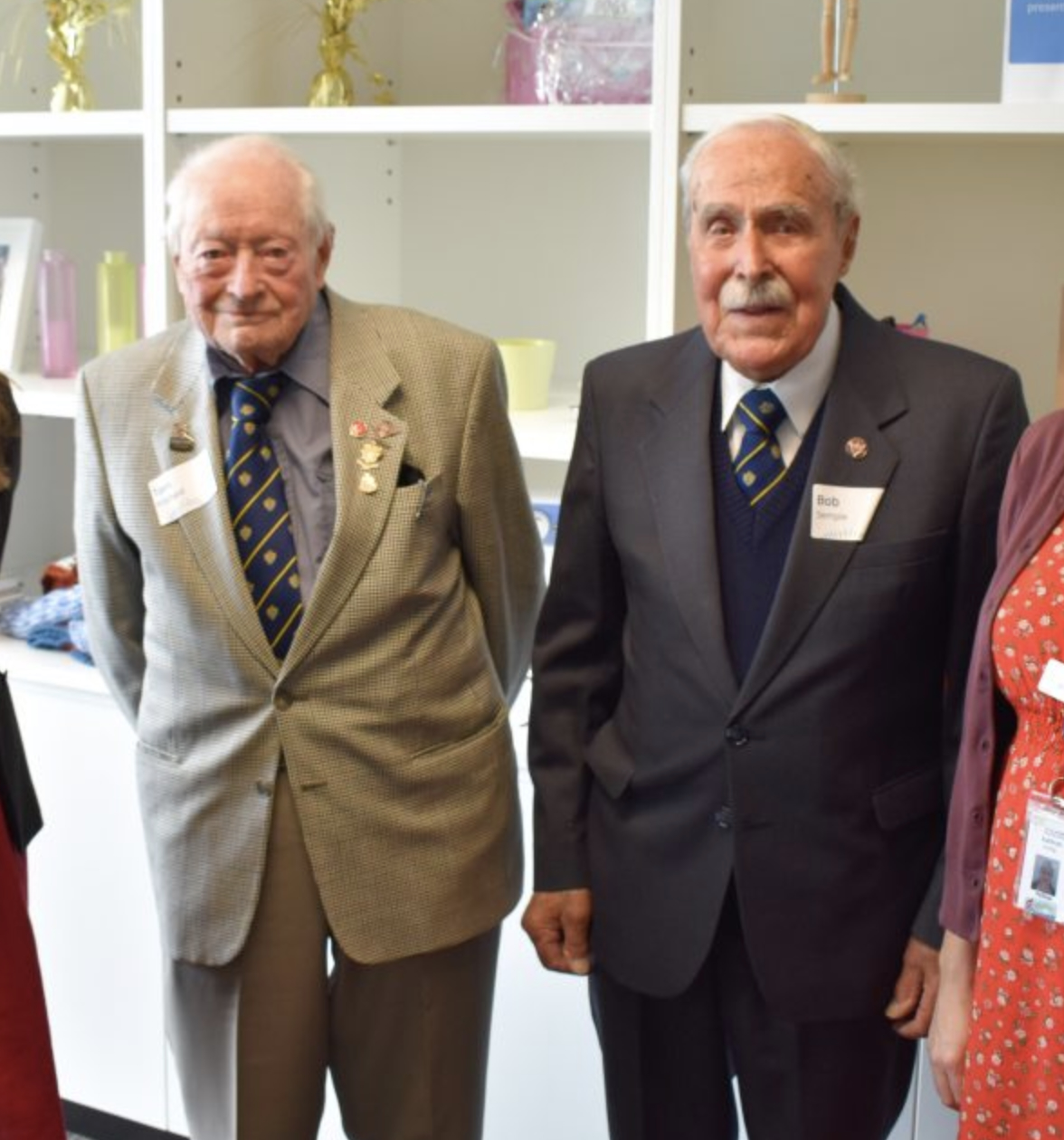
Tom Pritchard (born Portland Victoria 1919), who died in 2024 was the last Australian-born “Rat of Tobruk”. (Pictured in 2019, Tom Pritchard is with former President of the Rats of Tobruk Association, Bob Semple, who died in 2020 at the age of 100. Bob was a friend of the Polish “Rats”.
by Andrzej Balcerzak — English version
In November 1941, the successful Allied defence of the Libyan port of Tobruk came to an end. It was there that the German–Italian advance toward Egypt and the Suez Canal—one of the world’s most vital strategic routes—was finally halted.
From April 1941, the defenders of the city—later known as the “Rats of Tobruk”—held out against relentless attacks. At first, they were mostly Australian troops. Their resilience denied the Axis forces a crucial deep-water port and forced them to transport supplies from Tripoli, nearly 1,500 kilometres away, across the harsh desert.
As the months passed, exhaustion set in. The Australian government, also fearing a possible Japanese invasion, demanded that British command relieve its troops. In August 1941, the Australians were gradually replaced by British units and the Polish Independent Carpathian Rifle Brigade.
One may ask: what were Polish soldiers doing in the Middle East in 1941?
The answer lies in the extraordinary journey of the Carpathian Brigade—a story best told through the life of one of its soldiers: Władysław Krzysica. In Australia, he adopted the name George, and that is how he will be referred to here—with respect, but without formality.
George was born in 1923 in the small town of Czarny Dunajec, at the foot of the Carpathian Mountains. It was a place where music, poetry, and dance were part of everyday life. He learned to play musical instruments at a young age. Just before the outbreak of the Second World War, at only sixteen, he enlisted in the Polish Army.
In September 1939, Poland was invaded by Germany and the Soviet Union. Despite fierce resistance, the country could not withstand the combined assault. The promised support from France and Britain never materialised. Those who escaped death or captivity fled south. George was among them. His journey took him across southern Europe and eventually to the Middle East.
In December 1939, the Polish government-in-exile reached an agreement with France to form a Polish military unit in Syria. Thus, In April 1940, the Carpathian Brigade was created under the command of General Władysław Kopański.
The situation changed dramatically two months later when France surrendered to Germany. The Vichy regime attempted to take control of the Polish unit. The Poles refused and left Syria making their way to Palestine, where they joined British forces.
By January 1941, the brigade had been reorganised and officially became the Independent Carpathian Rifle Brigade. Soon after, as the Afrika Korps under Erwin Rommel advanced across North Africa, the brigade was moved closer to the front.
On 18 August 1941, the first convoy of Polish soldiers reached the besieged port of Tobruk.
Supplying the city and rotating troops was extremely dangerous. Ships travelled by night to avoid enemy aircraft. They were the only lifeline between the besieged garrison and Allied bases in Egypt.
George later recalled those days as a constant struggle against fear and exhaustion:
“When we arrived in Tobruk, the Australians showed us our positions. The next day, heavy bombing began and lasted all day. We hid in dugouts, caves—anywhere we could find shelter. German aircraft were above us day and night. It didn’t matter whether you were at the front or in the rear—you were never safe.”
Despite everything, he remembered the Australians with warmth. Language barriers quickly faded.
“We only knew a few words of English. We used gestures to communicate. They were good boys. They shared everything with us—even their beer, though there was hardly anything, not even water.”
After Tobruk, the brigade fought at Gazala before being withdrawn to Palestine in 1942. There, they joined the forces of Władysław Anders—soldiers and civilians who had survived Soviet prisons, deportations and labour camps.
On 3 May 1942, the brigade ceased to exist as an independent unit and became part of the Polish II Corps.
In the years that followed, these soldiers played a crucial role in the Italian campaign. At Monte Cassino, they helped break the German Gustav Line and opened the road to Rome. The battle was brutal, costing tens of thousands of Allied casualties.
George remembered the immense bombardment that preceded the final assault: “The ground shook for weeks. You could feel it even at the foot of the mountain.”
It was also during this time that he encountered one of the most unusual soldiers of the war—a bear named Wojtek. The orphaned bear cub was purchased in Iran by Anders’ soldier and became the mascot of the Polish II Corps. He liked the soldier life, assisted with carrying ammunition crates and to the delight of the troops, was even given the rank of corporal.
After the war ended in 1945, George and his comrades were transported to Britain. There, unwanted by the British, many faced a difficult decision: return to a Soviet-controlled Poland or begin a new life elsewhere.
Help came from an unexpected source—their former comrades from Tobruk. Australian Rats lobbied their government to allow Polish soldiers to settle in Australia.
Their efforts succeeded and the precedence opened Australia to other Polish soldiers who followed the Polish Rats of Tobruk.
In August 1947, George boarded the ship SS Asturias and sailed from Southampton. A month later, he arrived in Melbourne, before continuing on to Tasmania, where he would begin a new chapter of his life.
He worked on the construction of the Tarraleah hydroelectric scheme. Life was hard, isolated, and often monotonous—but for him, one thing mattered above all: safety and companionship of his colleagues.
He became an Australian citizen in 1949. A talented musician, he played the saxophone and formed a band with fellow migrants. They performed for local communities every Saturday night—music becoming a bridge between the Polish and Australian worlds.
Through a friend, he met Weronika, a Polish refugee from Wilno. They married and had two children. In the 1970s, the family moved to Melbourne. After his wife’s passing, George relocated to Queensland to be closer to his family.
In summary, George experienced an exceptional soldier’s life alongside comrades-in-arms from Poland, Australia, Great Britain, India, New Zealand, South Africa, and Czechia. Recalling these difficult times, George maintained a philosophical approach to life. He holds no grudges against his former enemies.
For the author of this article, conversation with George Władysław Krzysica was an extraordinary experience. George is a man who had not only witnessed history but lived it, much of it in extreme circumstances.
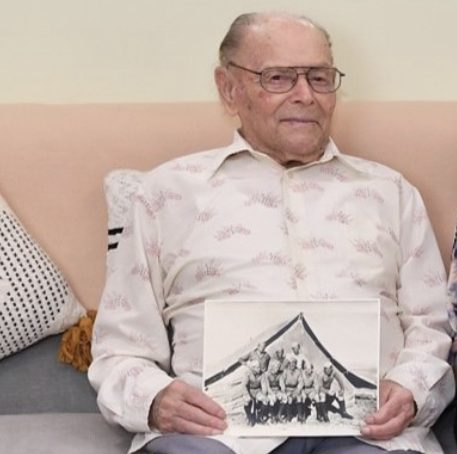
George Krzysica in 2025. Photo thanks to „Noosa Today December 2025”
But he is not only exceptional for his age, wisdom, and incredible memory. Władysław Krzysica is also a symbol and the last surviving “Rat of Tobruk.”
Andrzej Balcerzak
Note
(*) “Rat of Tobruk” – the term comes from the English traitor and German propagandist William Joyce, codename “Lord Haw-Haw.” He called on the besieged soldiers in Tobruk to surrender. He claimed that the soldiers were trapped in the rubble of Tobruk like rats and had no chance of survival. Australian and Polish soldiers adopted this insult as a symbol of honour, resilience, courage and endurance.